

Table of Contents
You’re a winning Hold’em player. You understand position, you read board texture, you don’t call off draws without the right odds. And yet every time you sit down at a PLO table, you bleed chips. The logic you’ve built over years stops working, pots spiral to sizes that feel insane, and somehow the fish keep cracking you.
It’s not a bad run. It’s a structural adjustment — a different game with different math, different hand values, and instincts that actively work against you until you replace them. This guide won’t waste your time explaining that the ace is the highest card. It’s written for someone who already plays poker and wants to understand exactly where their Hold’em edge carries over to PLO — and where it gets them killed — including how the action actually runs at X-Poker PLO tables.
Why PLO Exploded Right Now — and Where X-Poker Fits In
Pot-Limit Omaha has been the fastest-growing format in club poker through 2025–2026. That’s not a coincidence.
The tightening policies at major online rooms — GGPoker, PokerStars, 888poker — pushed a significant wave of regulars and semi-pros toward mobile club apps. Platforms like X-Poker, PPPoker, and PokerBros operate on a closed-club model: anonymous tables, private unions, no public player databases. It’s a fundamentally different ecosystem from licensed rooms, and PLO found a natural home there.
The reason is simple: recreational players love Omaha. Four hole cards feel like more opportunity — more combinations, bigger pots, more action. The casual player gravitates toward PLO far more readily than to a NLH table full of tight regulars grinding away with a HUD.

The result: the player pool at X-Poker PLO tables is meaningfully softer than NLH at equivalent stakes. That’s not a sales pitch — it’s a structural feature of where the market currently sits. But you can only capitalize on it once the fundamentals are locked in.
Two Rules That Make PLO a Completely Different Game
Everything that separates Omaha from Hold’em comes down to two structural differences. Treat them as axioms — everything else follows.
The 2+3 Rule: Why a Flush on Board Isn’t Your Flush
In NLH you can use any combination of hole cards and board cards: zero from your hand and five from the board, one and four, two and three — all valid. In PLO, the rule is rigid: exactly 2 cards from your hand + exactly 3 cards from the board. No exceptions, no flexibility.
This is where the most expensive Hold’em habit will burn you.
Walk through this hand:
Board:  A♠  K♠  Q♠  J♠  2♥
Hand:   T♠  9♣  4♦  2♣
Your Hold’em instinct fires immediately: Five spades on board, I have the T♠ — nut flush! No. To make a flush in PLO you need two spades in your hand. You have one — T♠. No flush. Your best hand is actually the Broadway straight: T♠ and 9♣ from your hand + J♠, Q♠, K♠ from the board. That’s it.
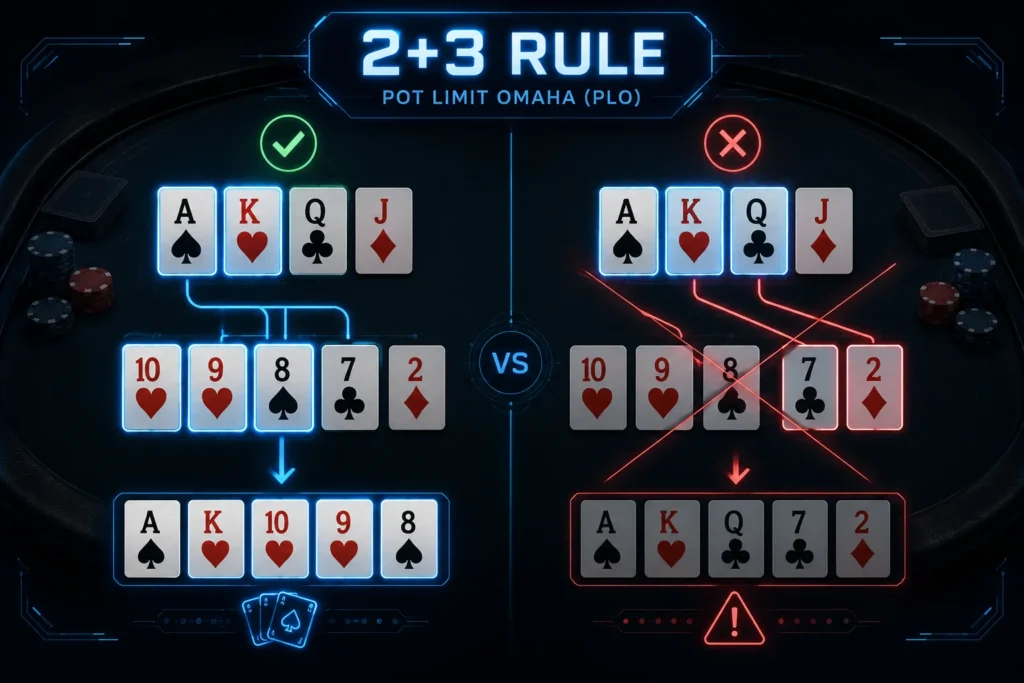
This seems obvious when you read it slowly. Under pressure at the table, with a pot building, experienced players make this mistake after dozens of hours in PLO — especially on monotone boards and when holding a low flush draw alongside board flush cards. Burn it into muscle memory before you sit down.
Pot-Limit: How to Calculate Your Max Bet in Three Seconds
In No-Limit Hold’em you can move all-in for any amount at any time. PLO caps your maximum bet at the size of the pot at the moment you act. That single constraint reshapes the entire game dynamic.
The pot-bet formula:
Pot-bet = Current pot + villain's call + villain's call
Shortcut: if the pot is $100 and villain bet $30 → max raise = (100 + 30) + 30 = $160
The most important consequence: you can’t just shove aces preflop in PLO. The pot-limit structure means stacks don’t go in preflop the way they do in NLH. Pots build gradually, and postflop play is mandatory — you can’t solve situations on the flop the way NLH players often solve them before the board runs out.
This is why position in PLO weighs even more heavily than in Hold’em. If you can’t play flop-turn-river well, no amount of preflop selection saves you.
Hand Values in PLO: Your Hold’em Intuition Will Lie to You
The read you’ve developed over thousands of NLH hands — the one that tells you a hand is strong — will systematically mislead you in PLO. Not because you’re a bad player. Because the valuation framework is entirely different.
What Makes a Good PLO Hand: Connectivity, Double Draws, and Nut Potential
The core concept in PLO hand selection is nut potential and connectivity. A strong hand doesn’t just contain powerful individual cards — it contains cards that work together to create multiple paths to the nuts.
Strong starting hands:
A♠A♥K♠Q♥— double-suited aces with connectors. Two nut flush draws + nut straight potentialK♣Q♦J♠T♣— double-suited broadway connectors. Massive wrap potential against most boards9♠T♥J♣Q♠— double-suited middle connectors. Huge wrap draws, flush draws, straight-making power
Hands that look strong but aren’t:
A♠A♥2♣3♦(rainbow) — naked aces with no suit and no connectivity. You can flop a set, but you’re wide open to the nut flush and nut straight. These are sometimes called “the worst aces in PLO” — they look premium and play like a trapK♠K♥7♦2♣(rainbow) — same problem: no nut potential, no redraws, hard to know where you stand after the flop
What’s a redraw? It’s when you already have a made hand and you’re drawing to a stronger one. You’ve flopped a flush, but you’re also drawing to a straight. If your opponent hits his out against your flush, your straight counterfeits him. Redraws barely exist in Hold’em — in PLO they’re a central part of how you evaluate your hand’s strength on every street.
Three Hold’em Reflexes That Will Cost You Money
No “be careful” platitudes. Here are the specific situations, and exactly how the mistake happens.
Reflex #1: Top pair top kicker is a strong hand
In NLH, TPTK on the flop is often good enough to go three streets for value. In PLO, on a board like K♠J♥7♦, your K♣Q♥3♦2♣ gives you TPTK — and that hand is, at best, a bluff-catcher. Opponents have too many two-pair combinations, sets, and strong draws. Playing top pair as a value hand in PLO leads directly to overpotting against ranges that crush you.
Reflex #2: A naked nut flush draw is reason to be aggressive
In NLH, a nut flush draw with a decent kicker usually has enough equity to semi-bluff. In PLO, a nut flush draw without additional outs is a weak hand. Against a set on the flop, your flush draw is around 35% equity. Against a set with a full-house redraw, you’re even further behind. Aggression without a redraw or added outs just burns fold equity you don’t have in spots you can’t win at showdown.
Reflex #3: A monotone hand is a strong hand
A♠K♠Q♠J♠ — four spades. The NLH brain says: nut flush draw, beautiful. In PLO, a monotone hand (all four cards the same suit) is significantly weaker than a double-suited hand. Why? You only have one flush draw, and it’s blocking its own outs. You’re holding 4 of the 13 spades — leaving only 9 in the remaining deck and at most 3 on the board to make your flush. A♠K♦Q♠J♦ is stronger because you have two independent flush draws working in different directions.
PLO Strategy for the NLH Player: What Transfers, What Doesn’t
The good news: a meaningful part of your Hold’em foundation carries directly into PLO. The bad news: a significant part needs to be rebuilt from scratch.
What transfers:
- Positional discipline — being in position matters as much, arguably more
- Board texture reading — dry vs wet board dynamics are conceptually similar
- Range thinking — the basic logic of hand ranges applies, though the ranges themselves differ
- Pot control — “don’t build a big pot with a weak hand” applies with even more force in PLO
What needs rebuilding:
- Hand valuation — full reset, as described above
- Semi-bluffing logic — in PLO you need redraws and connectivity, not just any draw
- Pure bluffing — bluffs work far less often in PLO due to wide calling ranges
Preflop in PLO: Play Fewer Hands, But Play Them With Purpose
The most common mistake Hold’em regulars make when they first sit in PLO: I have four cards — that means more combinations — I should play more hands. It’s a trap.
Yes, you have four cards. So does everyone else. PLO variance is high precisely because equity runs closer between hands. Play more junk hands and you’ll regularly find yourself in spots where you’re “almost there” against a made hand with a redraw — and losing a stack.
Enter the pot with hands that have a clear path to the nuts. No nut potential means you’ll be building big pots with second-best draws constantly.
Top 5 hand types to play:
- Double-suited broadway connectors (K♣Q♦J♠T♦)
- Double-suited aces with connectors (A-A-K-x, A-A-Q-x double-suited)
- Double-suited middle connectors (9-T-J-Q double-suited)
- Strong rundown pairs with backdoor equity (K-K-Q-J, Q-Q-J-T double-suited)
- Nut-nut potential hands with bonus equity (A-A-K-K double-suited)
“Any four cards” is the path to the felt. Even recreational players at X-Poker know better than to three-bet T♠7♦4♥2♣.
Postflop: Position and Nut Potential Decide Everything
On the flop in PLO, you’re not asking “do I have a hand?” — you’re asking “do I have the nut hand, or a nut draw with a redraw?”
A basic flop evaluation framework:
- Nut hand or close to it → bet, build the pot, size aggressively
- Nut draw + additional outs / redraw → aggression is justified, semi-bluff is credible
- Draw with no nut potential → proceed with caution, often check-fold
- Medium made hand with no redraw → bluff-catcher, don’t lead
Position in PLO postflop matters even more than in NLH. Playing out of position with marginal hands costs EV consistently — you have no information on how the action goes, and pots in PLO inflate quickly.
Bankroll and Variance: Why PLO Requires 2–3x Your Usual Buy-Ins
Most PLO content glosses over this. Let’s be direct.
In NLH, a winning player can run comfortably on 15–20 buy-ins over a large sample. The PLO standard recommendation is a minimum of 20 buy-ins to start; 30+ for real comfort. That’s not overcaution.
Why is variance higher? Because in PLO, the equity gap between the best and second-best hand on the flop is much narrower. Nut set vs nut flush draw with redraw is roughly 55/45 — sometimes as close as 52/48. The NLH equivalent of that situation might be 70/30 or 80/20. When you’re consistently playing large pots at near-50% equity, the standard deviation in results is enormous.
In practice: even as a winning PLO player, you can lose 10+ buy-ins in a row — and that’s a statistical baseline, not a crisis. Get your head around this before your first session, not during a downswing when you’re trying to rationalize what went wrong.
The first 10–20 sessions of PLO will be painful for almost every Hold’em player making the switch. Build that into your plan as tuition, not a sign that PLO isn’t for you.
PLO on X-Poker: How It Actually Works
Mobile Club Format vs. Traditional Room — What’s Different for PLO
X-Poker is a mobile poker club operating on a closed-club model. For PLO specifically, that creates a few conditions worth understanding before you sit down.
Table anonymity. There are no public screen names in X-Poker — you play inside a private club or union. This means HUDs and tracking software don’t function the way they do in standard online rooms. No hand history database, no long-term stats on opponents. This levels the playing field in favor of players who can read live action at the table — without the crutch of population stats.
Player pool composition. Mobile club apps have historically attracted more recreational players than traditional rooms. At X-Poker PLO tables, you’ll see noticeably fewer solver-polished regulars and more players showing up for the action and the big pots. For a skilled player, that’s direct EV.
Pace of play. The mobile format runs slightly faster than most traditional rooms. Factor that into your volume estimates and mental game preparation.

Stakes and Table Formats on X-Poker
X-Poker offers PLO tables across a wide range of stakes — from micro-stakes entry points up through mid-stakes for serious volume. The specific clubs and limits available depend on which union or group you’re playing in, since X-Poker operates through an agent and club manager structure.
For a Hold’em player making the move to PLO:
- Start 1–2 stakes below your usual NLH level — the learning curve is real regardless of your Hold’em record
- Cash games are the best format for learning PLO; tournaments add additional variables before you’ve built the baseline
- Standard stack depth in club format is 100 big blinds, which creates typical PLO postflop dynamics
For current club availability, active limits, and rake structures, reach out directly — the landscape shifts and a live conversation is more accurate than anything written in a guide.
Omaha Variants: What Else You’ll See at the Tables
Beyond standard PLO (pot-limit Omaha hi), you may come across:
PLO8 (Omaha Hi-Lo, “Omaha Eight-or-Better”) — the pot is split between the best high hand and the best qualifying low hand (eight or lower). It’s a fundamentally different game with a completely different strategy. If you see PLO8 and don’t know the low rules, skip it until you do.
5-Card PLO — each player receives five hole cards instead of four; the 2+3 rule still applies. Hands connect more often, variance is higher. Learn standard 4-card PLO first — it’s the dominant format and the correct starting point.
Classic PLO (four cards, high only) is the foundation and by far the most widely spread variant. That’s where the transition starts.
Want to Find the Right PLO Table on X-Poker?
PLO in mobile clubs isn’t one homogeneous market. Different clubs within X-Poker unions have different player compositions, different stake ranges, different rake and rakeback structures. A club that works well for an experienced regular might be too tough for someone still building their PLO game — and a club with a great recreational pool at micro-stakes won’t satisfy a mid-stakes grinder looking for volume.
We help match players with the right PLO club for their level, preferred stakes, and playing style. Not “sign up here” — actual personalized guidance based on knowing what the current pools look like.
Get in touch — we’ll find the right PLO club for your level and style. Free, no strings attached.
FAQ: Omaha and PLO on X-Poker
1. Can you use three cards from your hand in Omaha?
No — and this is non-negotiable. PLO requires exactly 2 cards from your hand and exactly 3 from the board. This is the core structural difference from Hold’em, where you can use 0, 1, or 2 hole cards. There’s no flexibility on this rule.
2. Why is PLO variance so much higher than Hold’em?
Because everyone at a PLO table has a stronger hand range, the equity gap between first and second-best hands on the flop is far smaller than in NLH. A nut flush draw with a redraw vs. a made set is roughly 45/55 — not the 30/70 you’d see in a comparable NLH situation. When you constantly play large pots at near-coin-flip equity, the standard deviation in results is simply enormous. That’s not variance to fight — it’s the math of the game.
3. What stakes should I start at in PLO if I’m a Hold’em regular?
Start one to two levels below your normal NLH stakes. Even a strong Hold’em player goes through a genuine adjustment period in PLO. Give yourself 20–30 hours of real play before moving back up to your usual level.
4. What’s a wrap draw and why does it matter?
A wrap is a straight draw with more than 8 outs — only possible in PLO because you hold four hole cards. Example: board is 8-9-T, you hold 6-7-J-Q. You have 20 outs to make a straight — combinations involving the 6, 7, J, and Q all connect differently against that board. In Hold’em, the maximum straight draw is 8 outs (an open-ended straight draw). A wrap is structurally stronger and is one of the central concepts in PLO strategy.
5. Is X-Poker legal?
X-Poker operates as a closed mobile club — a common model in markets where traditional online poker licensing is limited or unavailable. The legal picture depends on your jurisdiction. If you have specific questions about your country, reach out directly and we can give you a clearer picture.
6. What’s the minimum bankroll to start playing PLO?
Hard minimum: 20 buy-ins. Comfortable floor: 30 or more. PLO variance is substantially higher than NLH — a winning player can realistically drop 10+ buy-ins in a row over a short sample. That’s not a sign something is wrong. It’s the normal distribution of results in this game.
7. Can I play PLO on X-Poker from my phone?
Yes. X-Poker was built as a mobile-first platform — all PLO tables are available through the iOS and Android apps. Playing from your phone isn’t a workaround; it’s the intended experience.
PLO on X-Poker isn’t Hold’em with two extra cards. It’s a different game. That’s exactly why it’s still beatable for players who take the transition seriously — while NLH at comparable levels has never been harder.
Read also:
X-Poker Crashing? How to Fix App Crashes Fast
What Is an Agent in X-Poker, PPPoker? Roles, Responsibilities, and How It Actually Works
Poker Outs and Odds 2026: What They Are, How to Count Them, and How to Use Them at the Table
X-Poker Full Review in 2026: Download App, Find the Best Clubs & Join